
Massachusetts Is Rewriting the Ground Rules for Battery Siting
Massachusetts isn't simply encouraging virtual power plants. It's forcing utilities, developers, and regulators to ask a new question: When a constrained feeder needs additional capacity, should the answer be another utility-scale battery — or managing a portfolio of batteries, thermostats, EV chargers, and flexible loads?
The Department of Energy's Commercial Liftoff analysis puts current virtual power plant (VPP) capacity at roughly 33 GW across North America and targets 80–160 GW by 2030. That is enough to serve 10–20% of national peak demand. State mandates are multiplying, as are the discussions about how to implement them. The growing consensus is that VPPs are big, affordable, and coming to a grid near you.
That conclusion is correct but doesn’t tell the whole story. That question, the one Massachusetts is now formalizing, is easier to understand visually:
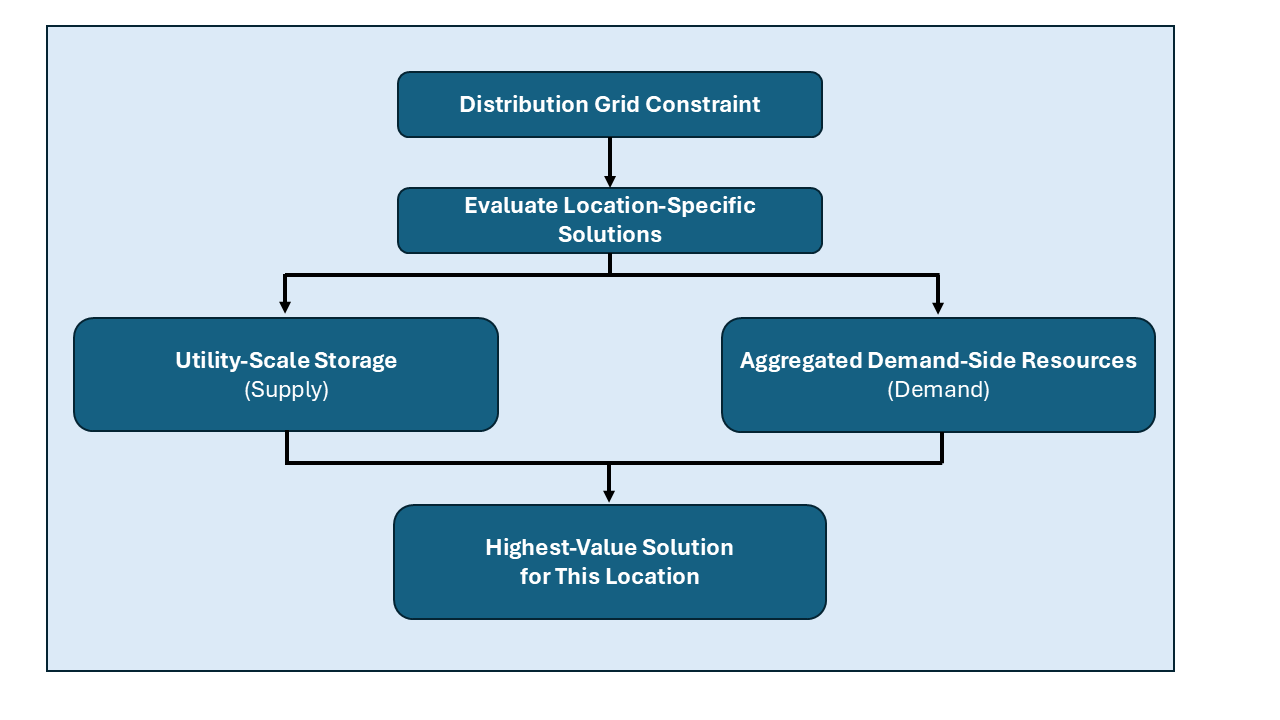
Massachusetts' Emerging Decision Framework for Constrained Feeders (CBR Energy Solutions)
What has changed in the Massachusetts VPP landscape
Three events in quick succession have set the stage for a surge in deployment of VPPs in Massachusetts.
First, Executive Order 654, signed by Governor Healey on March 16, 2026. The order includes a 3.5 GW target for demand reduction through energy efficiency, VPPs, managed EV charging, microgrids, and demand response. To put that number in perspective, the entire six-state New England grid summer peak demand was 26 GW in 2025.
The executive order directs the Department of Public Utilities (DPU) to require each utility to propose a comprehensive flexible interconnection program, expedite review of proposals that unlock time-of-use rates, DERs, and VPPs, and directs utilities to quickly implement approved measures. It also instructs the state to examine ways for large energy users to anchor virtual power plants or microgrids and monetize their energy management investments. A report due in September cataloguing existing demand-side programs will set a baseline and define what counts toward the 3.5 GW target.
The second shift is legislative. The Senate passed its energy affordability bill (S.3143) on July 1, a redrafted version of the one passed by the House in February. The two versions are now headed to a conference committee for what is expected to be a tough negotiation to reconcile the differences. The Senate bill would fundamentally reorient utility planning by shifting VPPs from a series of pilot programs into a statutory planning obligation overseen by the DPU, a provision the Senate estimates at $1.7 billion in avoided infrastructure spending over ten years.
The third is already happening inside utility planning. In the electric sector modernization proceedings, National Grid proposed an income-eligible VPP that installs a battery in a customer's home at no upfront cost. The company controls 80% of each battery's capacity and aggregates the portfolio as a non-wires alternative to address localized peak constraints while leaving 20% for customer backup. And in its 2024 grid modernization plan, National Grid identified at least two feeder expansion projects that could feasibly and cost-effectively be deferred for five years each by leveraging VPP programs. Together they offer an alternative to traditional grid infrastructure planning and investment by deploying distributed demand-side capacity in areas where grid capacity is constrained.
Massachusetts, like California, is combining existing retail VPP programs with a strong, DPU-enforced demand-side mandate. This state-level effort directly aligns with growing the wholesale aggregation arena, where ISO-NE and CAISO are among the first U.S. RTOs/ISOs to implement FERC Order 2222-compliant participation models. By successfully linking state-directed DPU requirements with a functional wholesale market, Massachusetts is emerging alongside California as one of the leading states for integrating retail VPP policy with wholesale DER participation.
Effects on siting
Front-of-meter storage developers have traditionally worked to understand where the grid is constrained, and whether they can acquire suitable land and permits near a feasible grid interconnection. Massachusetts now introduces another siting variable: could a distributed portfolio eliminate the need for another utility-scale battery altogether?
The economics explain why this question matters. DOE's comparative modeling estimates price 400 MW of resource adequacy at a net $43/kW-year from a basic VPP, versus $69 from a utility-scale battery and $99 from a gas peaker. The speed of deployment is also striking, with a basic VPP potentially operational in under six months for less than $1 million upfront, while the median utility-scale battery can take 40 months from interconnection request to commercial operation.
National Grid developed ConnectedSolutions in under four months for less than $500,000, and the program has grown to roughly 227 MW in Massachusetts. The region-wide, open-access version shaved 375 MW from the New England grid during the June 2024 heat wave. This is demonstrated performance and not just a projection.
The DPU's performance incentive mechanism for the efficiency programs that house ConnectedSolutions carries $190 million in profit potential for the Massachusetts IOUs over the 2025–2027 term. A precedent from New York is ConEdison's Brooklyn-Queens program, which deferred approximately $1.2 billion in traditional transmission and distribution investments. When a developer's interconnection application lands near a constrained substation, there will increasingly be a well-funded advocate ready to argue that a VPP should be evaluated first.
Yet this competitive dynamic remains largely theoretical today, and RMI's recent review of utility plans nationwide finds that most utilities still do not model VPPs as selectable resources on even footing with traditional assets — they assign fixed expansion rates, omit value streams, and exclude VPPs from the optimization that picks winning investments. The competitive pressure on a storage site is therefore not uniform; it is concentrated wherever policy forces the comparison. That is precisely what makes the Senate's comprehensive-planning provision consequential. If it survives the conference committee, Massachusetts will have legislated the balanced evaluation that RMI finds missing almost everywhere else.
This is not a zero-sum competition. In many locations, utility-scale storage and VPPs will be complementary rather than competing solutions. The important change is that planners will increasingly have to justify which solution delivers the greatest value at a particular location. That shift raises the burden of proof for what constitutes the right battery site. VPP capacity is real but bounded by limited duration, unproven winter performance at scale in the region, needed telemetry and measurement standards, and potential enrollment attrition. There are also grid reliability needs like multi-hour firm discharge, black-start-adjacent resilience, and guaranteed response in a specific location under N-1 conditions. The BESS developers who excel under the new framework will be the ones who can articulate which category of need their storage project serves and why aggregated demand cannot serve it.
Effects on the C&I facilities market
A similar logic about siting in the right location also applies to proposed and existing C&I facilities.
DOE's analysis estimates flexible C&I load in the U.S. at up to 300 GW today, and projects that C&I flexibility could constitute nearly half of all cost-effective demand flexibility by 2030. One mid-sized behind-the-meter battery can achieve the same result as dozens of enrolled households. The Massachusetts program design already reflects this, with ConnectedSolutions paying commercial participants $30–200/kW-year depending on the location and the number of annual dispatches. A battery or flexible load behind a facility connected to a constrained feeder is worth several times the identical asset several towns away. Some facilities are sitting on grid real estate considerably more valuable than their owners realize, and many are unaware of the potential opportunity.
EO 654 makes the invitation explicit: the state plans to find ways for large users to anchor VPPs and microgrids and monetize cutting-edge energy management systems. If you consider the underlying estimates from the state's own State of Charge study, with roughly 40% of annual electric costs driven by the top 10% of demand hours, the strategic plan for a shrewd facility owner becomes clear. It is important to understand your position on the distribution system as the programs are established, because much of the value is locational, and early participants at constrained nodes will capture compensation terms that may not be available to later entrants.
The same map from opposite sides
The BESS developer and the C&I energy manager will now be looking at the same map with different solutions. One asks where the grid's need justifies large-scale, grid-interconnected BESS facilities. The other asks what their existing load and demand flexibility are worth to the grid where they are located. Massachusetts will spend much of 2026 building the framework that can answer both questions with greater precision. The September baseline report, the conference committee results, and the early flexible interconnection filings will help establish the new rules.
A closing thought on what this all means for siting as this framework evolves. Site suitability screening and grid studies will need to be faster and more sophisticated. The state's methodology will mature, hosting capacity maps will evolve, and grid nodes that are constrained today may be relieved by new ESMP infrastructure.
What becomes more valuable is knowing how a specific utility actually deploys non-wires alternatives, how the DPU weighs demand-side substitution in practice, how programs price location, and how individual communities respond when either kind of project is presented. In a market where the demand side and the supply side now compete for the same constrained locations, the winners won't simply be those who build batteries or aggregate flexible loads. They'll be the organizations that understand where each solution creates the greatest value—and can prove it before anyone else.
For utility-scale storage developers, the implication isn't that fewer battery projects will be built. It's that the most successful projects will be those that can clearly demonstrate why utility-scale storage—not aggregated demand-side resources—is the right solution for a specific location.
CBR Energy Solutions helps developers, utilities, and energy-intensive facilities evaluate siting opportunities for battery storage, transmission, and distributed energy resources across Massachusetts and the Northeast.