
Why Constructive Approval is Not a Win
Massachusetts’ New Consolidated Small Clean Energy Project Permitting
The Cape Cod Technology Council Infrastructure Committee hosted a timely webinar last week on the new Massachusetts small clean energy infrastructure siting and permitting regulations (225 CMR 29.00). Nathan Raike of RENEW Northeast presented, and Connor Rockett of DOER answered some key questions from the audience.
What stuck with me were the questions. And how little we really know about how this process will work, less than two months before every municipality must accept applications under the new framework. What is clear is how many municipalities are still working to prepare for the new process and understand which projects will follow the different permitting pathways.
The uncertainty about which projects go through the new local consolidated process was highlighted by questions about a public-school canopy solar and battery project, and behind-the-meter projects. Another question touched on what happens if a single municipal board rejects part of an application at month ten, with constructive approval looming only two months later.
These were not objections, but rather municipal officials trying to understand how they navigate the new regulations and guidance. The questions kept coming, and more were probably in the minds of the attendees.
This new framework places a lot of responsibility on municipal staff and volunteer boards, and will require a host of new procedures. The flowchart below outlines the current and new local permitting pathways. I spend most of my time working for energy project applicants, but I am sympathetic to the new challenges faced by municipal officials. The challenges are added to existing obligations, as none of this replaces the conventional permitting pathway, it just provides a new option. Municipalities must be ready to accept consolidated permit applications while continuing to process everything else the way they always have. Which is why the webinar was so valuable.
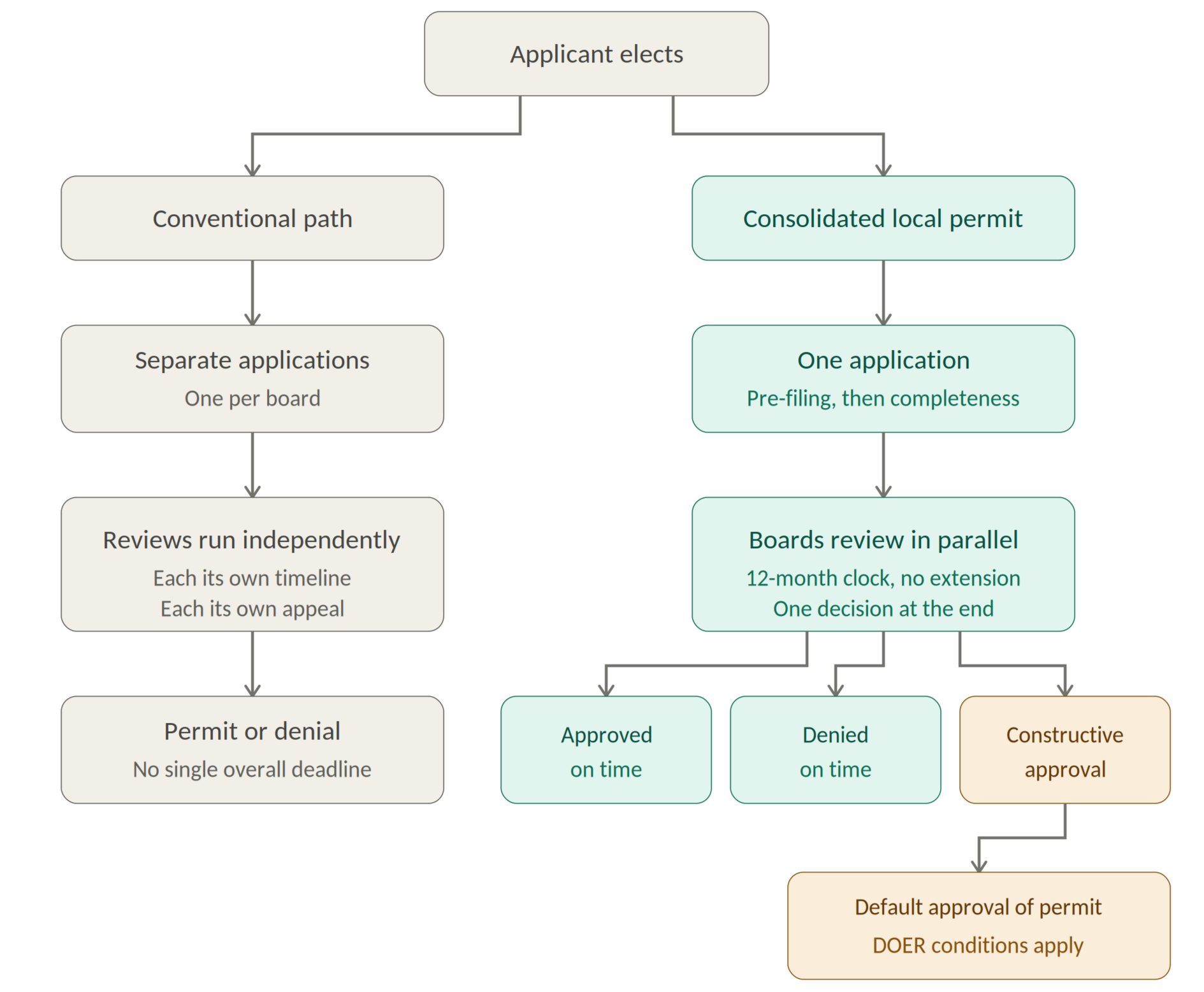
Two local permitting pathways: conventional path (remains an option) and consolidated path (new)
Constructive Approval Is Not a Win for Anyone
The new regulations don’t force a developer into the consolidated local process. They only are triggered if the applicant elects it, and an energy developer can still choose to go board-by-board through the traditional process. But an applicant not electing the consolidated local process gives up greater schedule certainty, a single decision, and the right to de novo review by the Energy Facilities Siting Board (EFSB).
What schedule certainty means is that if a municipality misses the 12-month decision deadline the consolidated permit is granted by constructive approval. And that deadline is firm — DOER is explicit that a municipality may not grant itself an extension. At first that may seem like a clear fail-safe advantage for the applicant. In practice, it is likely a worse outcome than a municipal decision.
Why wouldn’t an applicant want constructive approval? First, it automatically adds DOER's extensive list of conditions to the permit. Second, these conditions will be enforced by the municipality that just lost control of the approval process, likely frustrated by the process, the applicant, or both. Third, any future projects proposed by the developer will be received by a potentially hostile host community that remembers the prior outcome. The Commonwealth itself considers constructive approval a failure of sorts, since it requires its agencies to report if more than half of applications are constructively approved over two years, why that happened, and recommended changes to reduce the number.
Developers should want a municipality that rules on time and issues the permit.
Which projects are affected
Some small energy project applicants applying for a consolidated local permit will be exempt from the new site suitability scoring requirement, including generation constructed within a footprint of an acre or less, solar canopies up to 2 MW on a preexisting paved surface with a stormwater system, and small standalone solar (25 kW or less) and storage (250 kWh or less), along with generation and storage that is an accessory use behind the meter. And routine ministerial permits, such as behind the meter solar and storage systems, don’t have to go through the consolidated process.
The school carport example raised during the webinar is likely exempt from the site suitability and certain pre-filing requirements. That is important for both developers and municipalities to know before any applications are filed.
Three things that help both energy developers and municipalities
Municipalities must start accepting applications on October 1, 2026, so how should they and clean energy developers plan for the local process? While there are many ways to prepare, three are particularly important.
1. Designate a Local Government Representative.
The Local Government Representative (LGR) role is to steward an application through the local government. The LGR defaults to the Chief Administrative Officer (CAO) — the mayor, selectboard, or town manager — or a designee, or whoever the municipality names in a permitting bylaw. A new bylaw could be based on DOER’s Model Small Clean Energy Infrastructure Facility Siting and Permitting Bylaw, but adoption is optional.
The LGR’s critical role managing the application process includes certifying pre-filing steps, determining if the application is complete, routing the application among municipal boards, assigning minimization and mitigation measures, and issuing the consolidated decision. Municipal boards and departments still decide their own parts of the consolidated permit, but the LGR coordinates the process and has meaningful discretion over minimization and mitigation. DOER recommends designating working officials rather than leaving it with the CAO — municipal planner, building commissioner, planning board chair, conservation agent, and similar roles.
Two things are important for an applicant. A municipality can name more than one LGR, so the person who signs your pre-filing checklist may not be the one who determines completeness. And the body that assigns your minimization and mitigation measures, which become conditions in the permit, may be a planning board, a conservation commission, or a volunteer energy committee. Clarifying that early on is important for both the municipality and applicant.
2. Understand the boards and departments early on.
It is important to know who signs off on what step, how often each meets, and the hearing schedule. Under the new regulations, every board issues its own decision within the same 12 months. If any one of them denies the application, the consolidated local permit as a whole is denied. And if any one of them simply fails to act within the 12 months, the application is constructively approved. A board that lacks a quorum for a few months or is otherwise unable to act within the allotted timeframe can trigger the constructive approval that nobody voted for. An applicant should be preparing a realistic schedule with the details of each board and department in mind.
3. Look at the same data and tools required of the applicant.
The criteria-specific site suitability score comes from statewide tools and datasets applied to a project footprint. The applicant runs the tools and reports the scores before filing, and knows how and when those tools and datasets are updated and revised. A municipality can evaluate the same mapped conditions and scores, and the applicant, the municipality, or a local stakeholder can ask DOER to revise a score that was calculated on materially erroneous, incomplete, or otherwise faulty data. DOER’s model bylaw goes further and suggests municipalities build a score review into their intake process, consulting the relevant boards on whether a revision request is warranted.
Two more things worth noting. Applications will be filed through a new statewide permitting portal that notifies the municipality when a project is filed in their community. And DOER’s Regional Coordinators are available to provide technical assistance to both municipalities and applicants free of charge, including help with understanding the new process and suitability scores. It’s an advisory service, and not binding on the decision, but it is provided by the state for free.
The clock is ticking
The Cape Cod Technology Council Infrastructure Committee webinar was held before any projects have been filed on the Cape. This is the right time to prepare for the many changes that lie ahead. Municipalities that have sorted out their representative, prepared their boards and departments, and understand the new triggers and tools will be in a better position than those waiting for the first application to arrive. So will the developers who file in them.
Constructive approval is the one outcome on this list that nobody should want. So, a question for applicants and municipalities alike: what would it take, in your municipality or on your project, to make sure it never gets that far?
CBR Energy Solutions helps developers, utilities, and energy-intensive facilities evaluate siting opportunities for battery storage, transmission, and distributed energy resources across Massachusetts and the Northeast.