
Clean Energy Has Never Been Harder to Build — or Needed More

U.S. Coast Guard escorting an LNG tanker through Boston Harbor. Photo: USCG via Wikimedia Commons / CC BY 2.0
I've spent a lot of time over the past few weeks doing what I suspect many energy developers and regulators have been doing:
Watching the news from the Middle East
Tracking energy price spikes
And thinking hard about what it means for the critical work to develop and deploy energy.
Because this time, the shock is different.
The conflict that began February 28th sent oil past $100 a barrel for the first time in four years and shut down roughly 19 percent of global LNG trade through the Strait of Hormuz almost overnight. Europe is staring at an energy crisis. Asian economies are scrambling. The vulnerability of a global energy system built on fossil fuels, routed through narrow chokepoints, subject to the decisions of adversarial governments, has never been more obvious.
No blockade can stop the sun from shining, the wind from blowing, and batteries doing their thing. The case for domestic clean energy has never been stronger. And the urgency to build it has never been greater.
But urgency alone doesn’t build projects. And the path from “we need this now” to “here is a permitted, operating facility” has never been more complex or less forgiving. That’s the tension this industry needs to tackle.
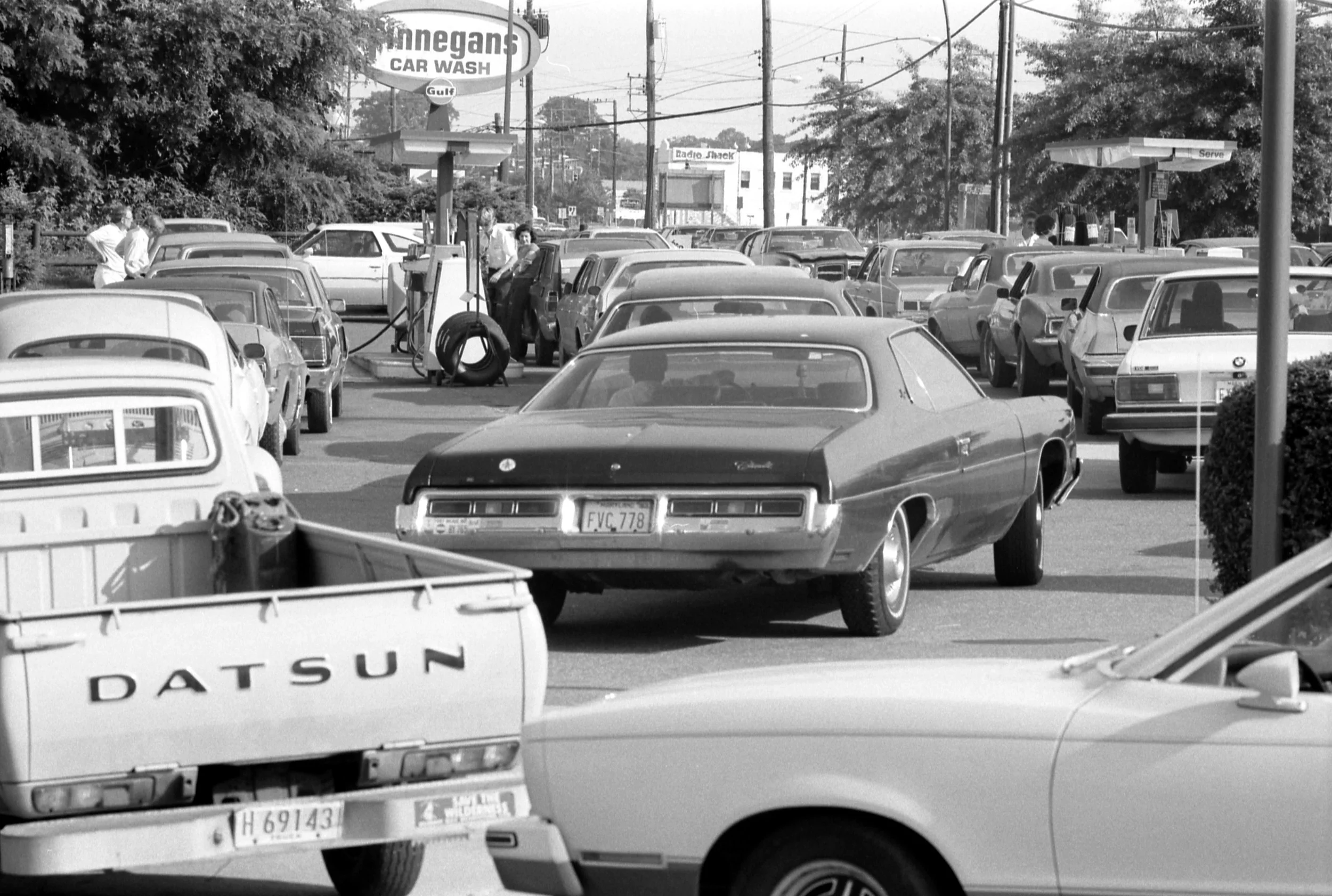
Gas lines at a Gulf station, Maryland, June 15, 1979. Warren K. Leffler / U.S. News & World Report / Library of Congress. Public domain
For those of us who remember being kids sitting in the back seat of their parent’s car in a long gas line — staring out the window, sulking about the cartoons going unwatched on the TV at home — the current headlines have a certain déjà vu quality. No iPads to pass the time back then, just the car radio and endless boredom. To be fair, we did learn some lessons: fuel economy standards tightened, and those gas lines helped spark early investments in solar energy. But here we are again, still routing a fifth of the world’s energy supply through shipping lanes just two miles wide — about the width of Central Park.
The Pressure Was Already Building
Before the first strike on Iran, the political ground beneath clean energy development was already shifting. Residential electricity costs have risen nearly 30% since 2021, significantly outpacing inflation. Since January 2025 alone, more than 112 million utility customers across 49 states face rate increases or proposals for increases totaling more than $92 billion. Some are calling it “the new politics of electricity, where electricity is the new eggs”, the kind of kitchen-table cost issue that reshapes political landscapes regardless of party or geography.
That shift has a direct consequence for developers: community acceptance is no longer a communications exercise. It’s a project risk. Ratepayer anger crosses party lines and doesn’t respond to complex explanations about load growth or capacity markets. Projects that land poorly in communities face a different and harder opposition than they did five years ago. The social license that the industry often treated as a given is now something that has to be earned with clear, sustained engagement.
At the same time, demand is surging in ways that weren’t in anyone’s planning horizon. Data center energy consumption alone is projected to grow from roughly 5% of total U.S. electricity use today to nearly 12% by 2030. Add electrification of transportation and buildings, and the grid faces a demand trajectory that makes the urgency of new clean energy supply not just a policy argument but an operational necessity.
There’s a particular irony in the data center number: the same AI tools that are beginning to improve how industry develops and regulators review new energy projects are also among the primary drivers of the demand that makes those projects necessary. The technology is simultaneously creating the urgency and part of the solution.
Urgency Doesn’t Override Complexity — It Raises the Stakes for Getting It Right
Here is where the current moment gets complicated. The geopolitical and economic case for accelerating clean energy deployment is now overwhelming. But wishing the permitting environment were simpler doesn’t make it so. And several forces are making early and mid-stage development more demanding, not less.
New regulatory frameworks are formalizing expectations that used to be negotiated informally. Massachusetts just enacted the most significant overhaul of its energy siting and permitting rules in decades. Other states are making similar changes. These frameworks don’t just add steps; they raise the cost of mistakes made before an application is ever filed.
Battery storage is the clearest example of technology-driven complexity. It’s one of the most critical technologies for grid resilience and one of the fastest-growing sectors in clean energy development. And it has encountered some of the most intense local opposition of any technology in recent years. Fire and safety concerns, real and perceived, have become a focal point for community resistance across the country. Getting ahead of that opposition, and not just responding to it, requires a level of front-end engagement, technical communication, and regulatory fluency that many development teams haven’t fully built into their process.
And supply chains remain fragile. Equipment sourcing, interconnection queues, materials procurement — the path from critical need to an operating project runs through each of these, and geopolitical disruption doesn’t clear those logjams. It just makes the delays more painful.
What This Means for How We Work
The energy developers and teams that build the most in this environment won’t just be the ones with the best projects or the strongest balance sheets. They’ll be the ones who have carefully planned for what front-end development requires.
When the margin for error was wider, when communities were broadly supportive, capital was cheap, and regulatory frameworks were slow but predictable, you could recover from a poorly scoped site, a contentious community meeting, a missed permit requirement. The project took longer and cost more, but it usually got there.
That margin is gone. Ratepayer anger makes communities less forgiving. Demand urgency makes every month of delay more costly. New regulatory frameworks mean that what you don’t know early doesn’t stay manageable, it compounds. The front end of a project is no longer the preliminary work before the real work begins. It’s where outcomes are determined.
The urgency is real. The margin for error is shrinking. The winning teams will be the ones that invest earlier and smarter in getting the fundamentals right.
CBR Energy Solutions works with developers navigating complex energy projects — from early-stage site and regulatory screening to community engagement strategy and permitting. If these shifts are changing how you think about your project pipeline, I'd welcome the conversation. Reach out at chris@cbrenergysolutions.com.